Ep81 David McIlroy—Why Chasing Likes Is the Wrong Growth Strategy (and What Works Instead)
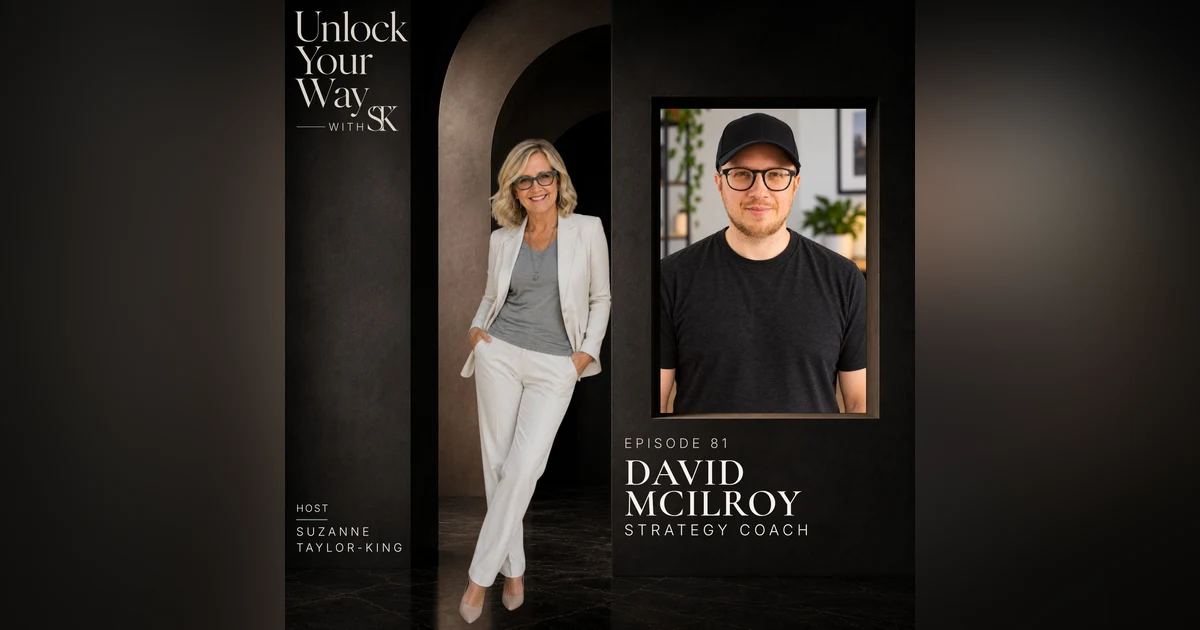
David McIlroy joined Substack in June 2023 with fewer than 200 subscribers who migrated over from another list. He never promoted it on social media. Today, 99% of his audience has come from inside the platform itself.
Suzanne sits down with David, a Substack writer and creator who helps other writers get their best thinking out of their heads and onto the page, to talk about what actually drives growth once the vanity metrics stop meaning anything.
David's take is blunt: likes don't tell you whether your business is growing. The real signal is what happens in the background: the DMs, the comments under an article, and the conversations nobody else sees. He builds his entire approach around connecting with people first and worrying about the sale later, if it comes up at all.
In this conversation, you'll discover:
- Why likes and vanity metrics are the wrong thing to chase if you actually want to grow a business
- The difference between marketing that makes people feel like they have a problem and marketing that simply opens a door
- Why vulnerable, self-deprecating stories build more trust than any polished pitch
- How David is launching Velocity, his new group coaching program for writers, by being upfront about the price from day one
- What changed on Substack after the Notes feature launched, and why it pulled in so many writers and journalists
David McIlroy 0:00
For me, it's always what happens in the background. It's the the conversations that happen in the DMs, in comments, under articles, and things like that. My goal right now, in particular, is to try and grow deeper with my audience. So I'm always trying to find ways to connect with them in a real way, human to human.
Suzanne Taylor-King 0:16
You build something successful, but growth feels harder than it should. You keep solving problems, but the same patterns return. What if the constraint isn't where you've been looking? Welcome to Unlock Your Way with STK. Each week, I sit down with founders, CEOs, and leaders navigating the messy middle of growth to explore the invisible constraints that keep successful businesses stuck. Because the problem you're solving may not be the real problem. Let's find out what is. Good morning, good morning, everyone. Welcome to another Friday live episode of Unlock Your Way with STK, and we are here today with David McElroy, a total stranger, I picked up on Substack, who writes about Substack, who encourages writers to write and get those thoughts out of their head, and I love his writing style. I love the authenticity, and he really writes with such passion. David, welcome to the show.
David McIlroy 1:25
Thank you so much. It's so nice to be here. I'm normally the one hosting podcast myself, so it's so nice to be on the other side of it today. So thank you very much for having me.
Suzanne Taylor-King 1:33
Oh, I better measure up then because you've had quite a lot of episodes you've done.
David McIlroy 1:41
Yeah, yeah. Um, I well, I mean, the way I structure the the titles of my podcast episode, just as a quick insight into this, is, um, it might seem as if I've done hundreds and hundreds of episodes, but I've actually done fewer than 100 so far because okay, I I structure them as, uh, in the same way that TV episodes would have been structured back in the day, so it'll be like season one, episode 12, that kind of thing, and then I'll cycle back to the the next the next season. So yeah, I'm actually under 100 episodes so far, but they've been really really good. Yeah.
Suzanne Taylor-King 2:13
Wow. All right. So let's let's back up a little bit. What did you do before you were writing on Subsac?
David McIlroy 2:21
Good question. So I was on Medium before Substack. I think a lot of people were, or they before they found Substack. As a freelance writer, I wrote for you know blogs, websites, social media, kind of content, the sort of stuff that paid the bills, but it wasn't overly exciting. I didn't have enough autonomy when it came to it, so I didn't overly enjoy that, but while I was doing that, I was able to establish my own business. I was able to write books. Was able to eventually feed my way into being a full-time solopreneur and writer and creator. So, do a roundabout journey, but I got there in the end.
Suzanne Taylor-King 2:56
Well, retrospection is always so interesting when you look back over your journey, it kind of all makes sense. What was the hardest part about actually making a living from your writing?
David McIlroy 3:11
I think finding ways to to attach income streams to it, I guess, because as most writers will know, it's very easy to write, and it's very easy to get your writing out there into the world. But it's not so easy to to monetize and make money off the back of it. So I think that's been still is a journey, but it's been a journey up to this point trying to figure out the best and most ethical and helpful ways of doing that for other people as well.
Suzanne Taylor-King 3:38
Yeah, yeah, I think that is one of the things, you know, working with entrepreneurs for almost 15 years now, and being one myself for 38. I don't like to admit that very often, but I think the common theme is I know what I do, but getting other people to understand what I do and and want to buy something that I offer, I I often see as such a business model problem. It's not an offer problem. It's you can't make a living selling a $27 thing if you only have 100 people on your email list, so it's a it's a real dose of reality, isn't it?
David McIlroy 4:25
Yeah, it is. Yeah, I mean, yeah, I I've been through that whole that whole phase of trying to sell low ticket offers and and tripwire offers, and they are helpful. They they fit into an overall ecosystem, but you're right. Unless you've got a massive massive audience and already have a lot of established loyalty and trust. It's very hard to turn that into something real.
Suzanne Taylor-King 4:46
Yeah. Oh, what did your subscriber trajectory look like? Did you start with followers on social media and then go to the medium and Substack writing? What did that look like?
David McIlroy 5:01
So I think I joined Substack in June 2023, so just over three years ago now. And I think at the time I migrated maybe like under 200 subscribers from another list somewhere else. So pretty much started from scratch. There was no real promotion on social media because even I did have an audience somewhere else, I didn't really want to. I felt a bit strange putting it out there when I was starting somewhere else. If you know what I mean, it's hard to kind of build from scratch and didn't really want to talk about it until I'd established it more. So Substack as a platform, at least in 2023, was incredible for just explosive growth. Really, my entire audience, 99% have come from within Substack itself.
Suzanne Taylor-King 5:42
Oh well, I love that. So I I tell my people all the time, and I I have a little mini course on on setting up your Substack. You know, from a structural point of view, like the way to think about it, and the emails, and you know the settings and what to charge and all of those things, but you do something really interesting. You're approaching it from the writing aspect. You know, helping people become better writers, and tell us a little bit about one where that comes from, but but also you you just launched something, and you know I've been watching it because I knew this was coming up, and I I want to just acknowledge that the authenticity of the launch, the emails, well done. You did a great job, but I, you know, I received over 40 DMs this week on Facebook and LinkedIn trying to sell me something, and I ignored every single one of them. But Substack is so different. Yeah, there's nobody DMing me trying to sell me, and I actually made a little like post about that today. Please don't let it happen to Substack also. But your your launch. Let's talk a little bit about what that looked like from a writing standpoint for you.
David McIlroy 7:26
Yeah. So if you're talking about Velocity, my my group coaching program, yeah. So that is launching next week. Um, I've been building towards it for a while. I've been doing one-to-one coaching with people for a while, and wanted to find a kind of phase into doing group coaching. I feel that's the right step for me. I love being part of a group, and I've said before, there's no better feeling and no no better kind of visceral energy that you get other than being in a group with people talking about the same sort of stuff. So I'm excited to to launch that, and yeah, I've been trying to do that in a real writing-based kind of way. I was sending out daily emails about it, and trying to just be very open about what it involves, about the price, all that kind of stuff. I I often find that people are launching a new thing that they try to hide the price somewhere in the back end and not tell you much it is until you're on a call, and so and I and I've I've experienced that myself. So I I wanted to try something different and just be upfront about it and say this is the cost of my program. If it's for you, fair fair enough, you can you can explore that. If it's not, that's okay. And I'm coupling that with doing a lot of live video kind of kind of stuff. So I did like a live walkthrough of the program where I just people could come along and watch me, and I would walk them through what it's going to involve. I'm going to subtag lives that we mentioned briefly at the start, and that's always really effective for connecting with people. So I always find that I'm sorry I'm talking too much here, but no, if you can have like a multifaceted approach to launching something, you're going to reach people in the right way. Some people like to read stuff, some people like to watch things, some people like to listen, and as long as you can kind of hit all those markers in a way that's sustainable and authentic, as as you said, um, you're more likely to reach the right people and and not in that way. Yeah,
Suzanne Taylor-King 9:16
I totally agree, and I think that's one of the things that I find so attractive on Substack. I've been there for about two years, and I I think my structure has changed, and I'm going to be adding a couple things to the menu bar that are different, and you know start here, and then my mini courses are all going to be on Substack. I'm actually taking a philosophy class that starts tomorrow from a college professor who writes a Substack about philosophy, and you know it's not for everyone. It's very niche, but he decided. To offer these mini courses on Substack. Well, I love the creativity of it. That you can have more than one vein of your writing. That you can have a podcast. You can build an ecosystem. You can monetize things if you choose to, and the internal growth that's happening for so many of my connections on Substack is really a whole business strategy in itself that in me is attracting more intellectual reading, do the work type people.
David McIlroy 10:38
Yeah, yeah, I agree. Um, I've I've seen a a real intellectual shift towards Substack over the last few years. I mean, whenever I joined it, it was still in that it had been around for a while, but it's still in that kind of early phase before it really started grow explosively. Um, I think I joined it shortly after Notes came along as a feature, and that really changed the game on Substack. But yeah, I I seen so many professors, as you say, journalists coming to the platform who had maybe been booted out from somewhere else, and they come to Substack and started their own thing, and which is amazing. Like independent journalism there too. So from a from a business standpoint, I don't see anywhere else online right now any other platform where it's as raw and ready to go as you mentioned LinkedIn, that kind of thing. Platforms where people are just constantly trying to sell you something. I feel like Substack is more community based. It's more about connection and real people, and people reading real writing as well. So it's a nice place to be.
Suzanne Taylor-King 11:39
I I think the well. Let's let's talk a little bit about how we connected. I subscribed to you. I don't know if you commented on something I did or vice versa. I liked. I I went right to your profile and looked at your notes and looked at some of the things you were saying, and I said, "Hmm, yep, I want to know more, which led me to be a subscriber. Now I'm going to be like a recommender of
Suzanne Taylor-King 12:12
Substack, which I think is amazing, right? So those people that add value to my ideal clients, that's a no-brainer for me to reach out to and say, you know, hey David, I love what you're doing. Would would you ever want to come on my podcast and talk about it? And I don't have to, you know, lead with, oh, I have this many subscribers and over a million downloads, BS. If if it's actually an authentic, at least on my like, I have to really like what you're doing, or I can't say I like what you're doing. And I think Substack really encourages that. Not that I don't post on Facebook or LinkedIn, but but I notice something about social media in general that if I post business content on Instagram or Facebook, I don't get any engagement. I and I have a lot of followers, but if I post my vacation pictures, Facebook shows it to everybody, and Subsec doesn't seem to have that type of favoritism algorithm thing. And what would you tell somebody who is kind of stuck in that going for likes and like I don't care how many people like hello LinkedIn don't care how many people like my post I really don't because that is not a driver or a marker of a successful business, in my mind.
David McIlroy 14:03
Yeah, yeah, no, I agree. I think I've spoken to so many people that you found Substack as well, who really obsess over those kind of metrics. Like they're like so many points they get that sort of thing, and there's an element in which they are important, of course, because it does show that you're you're getting engagement. But I think you're right. Likes, and I've heard someone else say this thing. J.K. Molina said it. Like seeing cash, you know what I mean. That doesn't really doesn't really mean anything in terms of business growth, that kind of thing. For me, it's always what happens in the background. It's the the conversations that happen in the DMs, um, conversations that happen in in comments under articles and things like that. Um, I my my goal right now, in particular, is to try and grow deeper with my audience. So I'm always trying to find ways to connect with them in a real way, human to human, and not necessarily because I want it to always lead to something. I just want to connect with people and see what happens. Not not because I want to sell them something, not because I want to get them into my program or get them to become a. Subscriber, just want to connect because I found that the people I've connected with in Substack over the years have gone on to be just great collaborators, great friends, great people who I like seeing on the platform whenever I turn on my computer or pick up my phone, and that I think is such a a rare thing right now online. It won't last forever on Substack, it will definitely lag everything. It will probably change at some point for the for the worse, but but right now in this moment in 2026, it's a it's a good place to be.
Suzanne Taylor-King 15:29
Yeah, I I before COVID, I ran an in person practice, I guess you would call it. I had a little office, and my clients came to my office. I had little events there for between 10 and 15 people, and those people that would come to my monthly event, 1015-they're, all still in touch today, and I'm still in touch with them. And there's something about the in-person connection for me. And I noticed I challenged one of my clients a couple weeks ago, who was struggling online a little bit. She's a very high-end coach, and she pays somebody to do her writing, she pays somebody to do her social, and so there's not an authentic connection there with the audience. Yes, she's not even aware of the audience, and I challenged her to do something in person. I said, "If you were going to have an event at a local hotel for two days, who would you invite? Who would who would drive? Like she's about six hours from me. Who would drive six hours or less to come and spend two days with you? And she messaged those 50 people Via email, and over 30 said yes and bought a ticket to the event. And she she hadn't even had a way for them to buy. Like she hadn't even she was like, oh my god, 30 people have said yes. What what do I send them? And I said, I got you. Like that's part of what I do, right? I can figure that stuff out very easily. But her people were craving her,
David McIlroy 17:30
yeah,
Suzanne Taylor-King 17:30
not a piece of content on LinkedIn or a newsletter that comes via email. And I I will add that when I was away on vacation, I just got back a week ago. I was away for 14 days, no email, no social on my phone, and I had a couple things scheduled when I was away, but I came home to 1500 emails. Not one of them was directly to me.
David McIlroy 18:05
Ah, okay.
Suzanne Taylor-King 18:06
So there was, you know, Claude checks my emails for me and lets me know if a client emailed or whatever. I'm like, I'm not even opening that inbox. I'm, I'm just deleting it because so much of today's content, emails, and things are noisy. You know, telling me I don't have something that I need.
David McIlroy 18:33
Yeah, yeah.
Suzanne Taylor-King 18:34
And you do something, and I don't, I don't know if you realize you do this. You don't make when I dove into your content, and it was gradual, and then more. You don't make me feel like I am missing something, like I have pain, and I need to solve it by hiring you, and this is this is a really interesting concept in marketing. You either market pain, and you make your clients feel pain. I don't want to do that, but you do it. You never made me feel inadequate, bad. It it really writes to the person who wants to do better, be better.
Speaker 1 19:31
Yeah.
Suzanne Taylor-King 19:31
Do you find that approach brings you a higher performing client?
David McIlroy 19:39
Yes. Yes, it's the it's the whole like heaven or hell kind of concept with marketing. Yeah, where either you're the you're basically describing the client situation as they're in a hellish situation, they have to get out of it, and you've got the way out, or that there's a a heaven situation they can't get to if they follow your. Your path, kind of thing. I I do think that, and I've heard someone else say this: that whenever you are trying to work with somebody or bring them into your program or invite them into your community, whatever it is, it should be an invitation. It should be a would you like this thing? It shouldn't be shoving them through a door, trying to like drag them through. It should just be here's the door open. You can walk through if you want to, and you want to stay there. That's perfectly fine, and that is that does find the face. I think of the way marketing generally is because usually it is all about real urgency and scarcity and all that sort of stuff, and trying to get people panic into buying something. And obviously, you need a little bit of that. And what you do, there has to be some urgency, otherwise people will never buy anything from you. But I do think that I like the idea of walking with somebody on a journey. If I'm a coach, if I'm in my community, whatever that might be, if they're reading my content, I'm there with them. Somebody else is on the same journey. I may be a few steps ahead of them, but I'm still kind of on the same path. I'm not the expert, not the guru, and not the person they have to get to. And I think whenever you have that that kind of "I'm your friend" approach, and genuinely think of it in that kind of way, think of all your people you work with as as friends or potential friends or acquaintances. And as I'm sure you know, you become friends with your coaching clients a lot of the time because you work with them very closely, and as soon as possible, not to after after a point. And I like to try and approach it from that way at right at the beginning. This is this person could could be a friend. This person is another human being. They're not just a number. They're not just someone I'm selling to. And how would I like to be approached if I was on the other side of that journey? So everything I do, I try to frame it in that in that kind of way, and actively reject the usual marketing like tricks and tactics.
Suzanne Taylor-King 21:47
Well, it I can feel it, and I notice it. So I I do notice those things in the online space after 15 years, which is really interesting. That you know, as I'm discovering you, and you know what you
David McIlroy 22:04
do,
Suzanne Taylor-King 22:05
I immediately saw. I'm a huge fan of Pat Flynn, and I I love Daniel Priestley, key person of influence. You very quickly, without meeting you, I noticed. I'm like, well, this is influencing me here, and I loved it. So, what, wherever that comes from in you, um, what do you think that is like? Where does that insight, like, for me, my my insight like that comes from the fact that I was a dental hygienist for 20 years before I became a coach. Starting businesses on the side, I would leave dental hygiene and start a business, and then once it was up and running, I would go back. Great benefits, great pay. What it it was more than it it was the fact that it was a new person every hour, 30 hours a week, and it was this way of connecting psychological safety, of course. I'm gonna clean your teeth with sharp instruments, so you have to feel safe with me, right?
Speaker 1 23:30
Yeah,
Suzanne Taylor-King 23:30
and and doing it in less than a minute was such an unconscious ability for me. You have that unconscious ability in your writing. Where does that come from?
David McIlroy 23:49
Well, first of all, I just want to say one of my very close friends is a dental hygienist as well, so that's funny. So she, I've seen her go through that, and she really loves loves the profession. But yeah, I think I think for me, I I'm a natural introvert, and someone doesn't like to be at the croft. Yeah, yeah, very, very much so. And I was saying to someone in our group last night that the kind of conversation we're having now, if you told me three years ago that I'd be doing this, I just would be like impossible. I couldn't possibly do that. So yeah, I I developed this this ability to peer extrovert over over time, and I think that natural introversion and natural preference to be in the background and to not be at the forefront of everything means I'm I'm very interested in other people and want to hear what they say, and I I love listening to them. I love drawing things out of other people and understanding what their passions are and what they're good at. Because I find that so often people can't tell themselves what they're good at. They they'll talk to me about things. They'll say stuff like, "Oh yeah, I do this, this, this. And I say, "Well, what you just described is absolutely incredible, and I can't do that. A lot of people can't do that, but you do it easily and." Can we explore how to how to draw that out of you? Basically, that's what coaching's all about for me. I used to work with young people, and I used to have conversations with them all the time in these kind of settings. And they would be telling me stuff, and I was just always amazed by how much potential they had as as young teenagers and what they could go on to do in future. And I see that in adults as well, and haven't haven't explored that or tapped into it enough, so I think it's that that interest I have in other people more than myself, and I've been at genuinely in what they're capable of doing, what they're able to do, and trying to see how to to draw that out of them, and I just love that. That fills me with a lot of joy and passion.
Suzanne Taylor-King 25:37
Well, I'm shocked and Surprised that you know. So after after this conversation, you'll probably disconnect and be a little more introspective. And I find that with introverts, right? It's you know they might be able to turn it on for an hour or three hours, but then it's the introspection and the internal curiosity. It's great to be curious about other people. I think it's fascinating, and I, you know, obviously I do a podcast, and I it's a bunch of different people, right? But I think it's the the curiosity about myself that's actually really allowed the business growth, and I love that you, you know, are willing to talk about that. For one, what would you tell somebody who was an introvert or is an introvert, and they're nervous about putting themselves out there, being vulnerable, even even writing something vulnerable.
David McIlroy 26:47
Yeah,
Suzanne Taylor-King 26:48
advice.
David McIlroy 26:49
Yeah, we we literally had a session about this last night in our group, which is so so funny. What I would say is, if you are if you're nervous about say being in front of the camera or something like that. Do it with somebody else. Have a co-host first of all. So say you're doing a Substack live, and a lot of people want to do this, but they're very, um, they're very nervous about being in front of the camera. What do I say whenever I'm there? What if I freeze up? You know, what if no one shows up to the to the conversation? Um, I always just say bring somebody else with who you're comfortable speaking to. Um, somebody else from Substack or whatever have a conversation like we're having right now, and it makes it a million times easier. Just pretend nobody else is there in that kind of situation. And I mean, last time we talked about tactics you can use, like pretend your audience are all naked and like kind of those kind of things or whatever. But like, which doesn't really work for the most part, I think. But it's things like that. It's trying to just understand that other people really aren't judging you. They don't really care that much about if if you make a mistake or if you trip up in your words or or whatever. They just wanna they just wanna hear what you have to say and how you go about saying it often isn't really that important. They just wanna wanna get the value from you if they can. So if someone is nervous about it and if they're nervous about sharing in their writing and being vulnerable in that sense, I guess what I would say is, and we talked about this last night, story is is one of the greatest drivers of connection, and people remember what you talk about. I remember what you write about, and vulnerable stories, to an extent, obviously, are probably the most potent tools you can have as a writer and a creator. If you can share a vulnerable, slightly self-deprecating story about yourself, people will remember it. They'll trust you because of it, because you're brave enough to do that. And if you can learn to articulate that on camera as well and tell stories in that way, that's even more powerful because they get to hear it directly from your your own lips and and see you say it in real time. So, if you're nervous about doing it, what I would say is have somebody else with you, take that first step, and know that no one's going to be judging you at the start.
Suzanne Taylor-King 28:50
Love it, love it. Well, I use humor. I remember when I was studying positive psychology, I found out that my top character strengths were love of learning, humor, and compassion. And I was like, "Huh, how can I use those three things every day? And I know that making people laugh removes any fear I have at all,
David McIlroy 29:23
yeah.
Suzanne Taylor-King 29:23
And I I can remember one of my first times on stage in front of about 300 people giving the talk. Don't even remember what the talk was about, but I remember getting heckled. Like someone in the audience who knew me said something snarky and funny, and I literally turned and directed right at him and made like a joke, and the whole audience broke up in laughter, and I was like, "That was the best thing ever. You thanked him afterwards. I said, "Thanks for the heckle. That was phenomenal." And like not for me, but you know, for me, like making other people feel comfortable and valued and capable of something greater than they believe they're capable of.
Speaker 1 30:19
Yep.
Suzanne Taylor-King 30:20
Let's talk a little bit about what you're doing with velocity, and because I think it's doing just that. You know, I know I'm a decent writer. I do use AI to help me synthesize and combine ideas. I have a series where I kind of combine Napoleon Hill and like that old business wisdom with Stoic philosophy and modern business, and I saw the intersection. Somebody else might see not see that, but I use AI to you know synthesize ideas, but I do the writing, and as as I'm thinking about being a better writer, doubling down on my Substack and that way of connecting with people, what does velocity look like, and how do you improve People's writing,
David McIlroy 31:22
yeah. Well, Velocity is a group coaching program. We meet once a week for maybe say 75 minutes in a session, just to kind of explain what it is. There's a few different elements to it, like general catch up, a bit of a hot seat mini coaching session. I'll teach for a little bit. I just literally show some slides and walk through a topic, and then there'll be a group kind of discussion at the end, and with a challenge as well. So the the whole focus of it really is to kind of get everyone working together, talking, sharing ideas, and bouncing those things off each other. And the way I think that helps people become better writers and better creators is you can talk to yourself in a vacuum or talk to Claude or ChatGPT until you're blue in the face about your ideas and what you want to do. It's only when you speak to another person, I think, and you get their reaction, you get their facial response to what you're what you're saying, get the energy coming back and forth from them, and they tell you verbally what they think of what you said, give you some feedback. There's nothing more effective or powerful than that, I think. And having a really concentrated, safe space in which to do that, I think, is just incredibly powerful. So, if someone came into the the room in Velocity and we were talking about your headlines on Substack, like how do you write better headlines? That will be one of the topics that we cover. We can all share headlines that we think are really good. We can share where we've had problems with writing headlines and kind of workshop through that together. I can sort of direct the conversation and give them my thoughts on it. Give them some things to kind of work from. But I just love the conversation that happens around that kind of stuff and people come up with things in real time. It's really, really powerful. Yeah.
Suzanne Taylor-King 33:03
Do you do you notice as an introvert that a group coaching scenario actually was a little intimidating at first, like pulling a group together?
David McIlroy 33:18
Yeah, it definitely has been a learning curve, I think, as an introvert, because again, I have a bit of background in this because I used to be a youth worker, so I used to have to wrangle young people into into settings. Yeah, yes, exactly. I really just well, even even being like a facilitator in a conversation, there's there's elements of it in that too, and be able to kind of keep the conversation move in the right direction. So yes, as an introvert, initially that is quite difficult to kind of become accustomed to because I like having one-on-one conversations like this, and it's different when there's 10 people there instead and trying to manage that. But it's a it's a it's a learning process. You get better at as you do it.
Suzanne Taylor-King 33:56
Yeah, I I think I I've met so many people when I first started out with coaching groups and facilitating on Zoom, and I remember struggling a bit with the people management, not the content. It was more, you know, oh, this one only talks for 10 seconds, but I know there's more that person could say, and then this one overtalks and like managing that was really the skill I had to learn. It wasn't the coaching or the content, and I think my message to coaches who you know want to have groups? It's it's really learn that you know it's not your content doesn't need to change for a group. It's the interaction, the value in the room. It's your job as the facilitator to really pull out the value in the room. It's not just about me there. It's about the wisdom in the room, so I think that would be really fun to explore with you. So, if anybody listening is interested in that, please comment, and I will happily share that information. And I do something else that one of my followers who's listening, Gordon. Thank you, Gordon. I have a newsletter that reports on things in AI, and it's written in a persona. How do you feel about writing in other personas?
David McIlroy 35:38
Well, I mean, as a fiction writer, I do that all the time, so I very much love that. Yeah, it's a it's a joy to do that, and even I suppose thinking about it in a nonfiction sense for using Substack and things like that. Yeah, I like the idea. I haven't really explored it an awful lot in a nonfiction way just yet. Although on Substack, I've started another publication which promotes my my fiction writing directly, and I write as somebody else as a character there, and that. So it's it's obviously me writing it, but um, I write it from a different perspective. So that's a different
Suzanne Taylor-King 36:13
thing. Nice. Oh, I can't wait to check that out. Make sure to send that over me. Um, my my persona is a combination of me, my mom, June Cleaver, and an IT person who's literally out of touch with AI news, and she writes after she's had a couple martinis. So it's very funny
David McIlroy 36:40
for that,
Suzanne Taylor-King 36:41
and she smokes too, and so it's like this other side of me in a way that's you know stand up comedy, but she's reporting on AI, so it takes away the fear of learning about AI. Number one, and you know there's some crazy things in the AI news world. Monday's article, which I'll I'll send over to you so you can have a chuckle. She's writing about the thing Meta turned on this month for three days, and then they turned it off. It was a tool that you literally could tag anybody's Instagram profile and make videos or images with that person. Okay, I don't know if they intended it to to be something where you could copy other people, but that's in three days. That's what it turned into. It turned into oh, let me tag some famous movie star and spin up a whole channel of that person. So it was very nefarious, you know. Within three days, and they turned it off. So she's reporting on that like it happened to her.
David McIlroy 38:08
Okay, I love that. I'm really glad,
Suzanne Taylor-King 38:11
yeah. Yeah. So I'm having a lot of fun with it. What's your advice about having fun with what you do? I'm always curious about that.
David McIlroy 38:21
Oh yeah, oh, it's so important to think. Yeah, and I'm the kind of person that if I don't have fun with something, I really struggle to stick at it for a long time. So it has it has to be something that I feel passionate about, and that I will whenever I sit down at my computer to write or create whatever else. It has to be something I'm really going to enjoy doing. I'll walk away from otherwise, and I'll just leave it. I've learned that about myself over over time. So yeah, if I can if I can gamify things in any way, if I can make make the challenge for myself in some capacity with the way I write or the way I create, that's why I do things like with my podcast. As I said, that the it's it's structured like a like a like a little school TV series, there's 22 to 24 episodes per season, and then it starts the next season, that kind of thing. And just to make it fun for myself, and if I do lives with people or I podcast episodes, they're people I actually want to talk to. It's not just because I think this would be a good person, like in terms of my growth or something like that, to speak to. Because I want to have a conversation with them about whatever it is they talk about, and I'm interested in that. And again, if I'm not interested in it, I'm probably not going to want to talk to them. So that will bleed over into my my audience, and as well, they will sense that energy coming from me as well, or lack thereof. So yeah, it's super important to have fun with it.
Speaker 2 39:36
Yeah,
David McIlroy 39:37
I think it's not it's not just passion; it is fun. You be passionate about something, and I'll enjoy it in a sense. If that makes sense, yeah. And in terms of the the way you deliver it, yeah, fun so important.
Suzanne Taylor-King 39:48
I love it. I love it. So now I'm curious why you said yes to me.
David McIlroy 39:56
Well, I guess. On the one hand, part of it was because I actually gave very few invitations for podcasts myself.
Suzanne Taylor-King 40:05
Really?
David McIlroy 40:06
Yeah. So, like, I was delighted that you that you reached out to me and asked me to be on it for one thing, and then secondly, like you did with me, I went and checked out your profile and checked out what you do, and I thought it was really interesting. And again, I wouldn't necessarily have said yes if I didn't think you were someone who would be interested to speak to. So just a little tiny bit of of research in the back in the back end just led me towards a yes in that in that regard. Yeah,
Suzanne Taylor-King 40:32
I love that. I love I love that. You know sometimes I've I've reached out to some really well known people, or people with a lot of followers. I don't even know how many you have. I don't care, but I I've done that, and they've said the same thing. So I I want my audience to remember if you're reaching out to people, Authors, speakers, potential guests for your podcast, and you're intimidated. Remember, the the more famous or the more followers or the more you have someone on a pedestal above you, the the less people are reaching out to them. Yeah, yeah. And I remember Dr. Ben Hardy, who wrote "10x is Easier Than 2x. Phenomenal person, and I reached out just to thank him, not thinking it was actually going to reach him, right? But I wanted it out of me. Like that book made such a difference in my business two years ago, and I let him know what what it did for me and how it, you know, doubled my income in a very short time. And thank you so much for making a difference in my life. And you know, he has five adopted children. I have one, and you know, I just said that. I just said thanks for all you do, and he answered, and we ended up back and forth. We ended up on a call. Like he said, nobody ever reaches out to him, and I was like, wow, such a reminder to just do it with authenticity and vulnerability, and thank you, thank you. Yeah, saying yeah,
David McIlroy 42:26
yeah. You'd always be yeah, and and thank you so much for having me. I really appreciate it. It's so nice to be here. Um, and yeah, you're so right. People people forget that there's a human on the other end of the line sometimes sending out these emails or or doing these podcast episodes or whatever it is, or create these YouTube videos, and so often as a creator, it's very lonely, and you don't hear from anybody else. And you often know if your audience are actually even liking what you're doing, because not everybody who is in your audience is going to like your stuff, like physically click the like button, or leave a comment, or buy something from you. But they may absolutely love you and what you're doing, but they're just not the kind of person who's going to reach out. So, whenever somebody does, I would always recommend save that email. Excuse me, save that comment, screenshot it, put it in a folder somewhere, and go back to it and remind yourself every so often that someone likes what you do because otherwise it might not work. Yeah,
Suzanne Taylor-King 43:18
yeah, such a good reminder. Well, any final tips before we wrap up? One, you need to subscribe if you're a writer, writing content, writing long form content especially. But you could improve someone's LinkedIn content Tremendously, and any final words of wisdom for my tribe?
David McIlroy 43:47
Yeah, I mean, I ask people this question as well myself, so it's it's hard to be in the other side. Bill, yeah, I mean, like we said in the course of this conversation, if you're nervous about doing the thing, whatever it is you want to do, just just do it. Bring somebody else on board with you to make it easier at the start. And know that no one is going to be watching and waiting for you to feel whatever it is you want to do. Just just try it. There's there's so little downside as a creator to just taking a bit of a bit of a risk and a step, and you don't know where that could lead to further in the line. I didn't know when I opened my Substack profile that one day would become like my main source of income or lead to my main source of income. And I just thought it was another platform, and I'm I'm so glad I did it. So take that step.
Suzanne Taylor-King 44:34
Love it. Thank you so much, David. Appreciate you. Look short to hearing about velocity and the difference you make for people, so I'll share all your links in the comments. And you know, thanks again for joining me, and everyone, follow David, head over to my Substack or subscribe to his. All you do. Is go to Substack and search David McElroy, and his publication will show up immediately. So, thank you, thank you, thank you. Look forward to more conversations.
David McIlroy 45:12
Thank you so much.
Suzanne Taylor-King 45:13
Thanks for listening to Unlock Your Way with SDK. If this conversation surfaced something for you, a question, a pattern, a realization you can't ignore. Don't sit with it alone. Reach out. The first step is always a conversation. Book a private call. Visit suzannetaylorking.com because clarity doesn't come from more information. It comes from seeing the constraint you've been missing.