
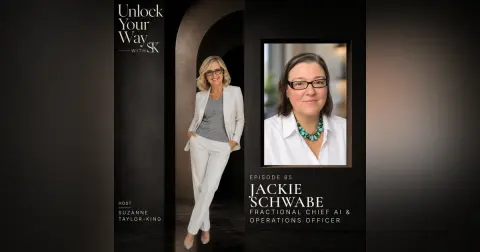
Ep85 Jackie Schwabe—How to Use AI to Finish What You Start and Book More Sales Calls Without Hiding Behind a Funnel

Got a pile of half-finished projects and a nagging feeling you should build one more thing before you start selling?
Suzanne sits down with Jackie Schwabe, an AI builder and coach with a computer science degree, a master's in technology project management, and International Coach Federation training. Jackie has taught at Cornell and now builds custom systems with Claude Code, from a content flywheel that handles her post-call workflow to a tool that turns a metal fabricator's blueprints into a bill of materials.
Suzanne shares her own results: a complete content flywheel plan in two hours that would have taken her around 40, and competitive research that dropped from six hours to five minutes. Together they get into why a plan matters before you build, what honest business math looks like, and how real conversations on LinkedIn fill a calendar.
In this conversation, you'll discover:
- How to plan before you build, and why a good-looking app can still be a lazy build that disappears when your browser refreshes
- How Jackie's content flywheel turns every live Zoom call into a YouTube upload and a follow-up email to attendees without her lifting a finger
- How to use AI to run the numbers on an offer before you build it, starting from the list you actually have instead of a 10-step program from someone with 60,000 subscribers
- Why Suzanne and Jackie call it irresponsible to promise that a $27 course can replace a salary
- How Jackie gets three to seven sales calls a day from LinkedIn conversations and an email list of about 500 people
- How to ask AI questions the way a coach would, so it pulls your best thinking out
- Why Suzanne calls the hours AI gives back "time wealth," and what Jackie does with hers
Jackie Schwabe 0:00
Now I say yes. I say yes even if I don't know if I can help them. I say yes even if I think they're trying to sell me something. I say yes even if I have no idea who they are and how I met them. I've had some of the greatest conversations of my life,
Suzanne Taylor-King 0:21
you build something successful, but growth feels harder than it should. You keep solving problems, but the same patterns return. What if the constraint isn't where you've been looking? Welcome to Unlock Your Way with STK. Each week, I sit down with founders, CEOs, and leaders navigating the messy middle of growth to explore the invisible constraints that keep successful businesses stuck. Because the problem you're solving may not be the real problem. Let's find out what is. Good morning, good morning, everyone. Suzanne Taylor King here for another Friday episode of Unlock Your Way with STK. I'm STK, and this is the incredible, the incomparable, the woman I'm slightly obsessed with her AI affiable building skills. Jackie Schwab, welcome to the show.
Jackie Schwabe 1:22
Thank you. Wow, I love the intro. Can I bring you to all of my yes, yeah, my stuff? You could just intro me. That would be great.
Suzanne Taylor-King 1:31
I would love that. Actually, I would secretly love that. And if you want me to leave you a voicemail or a WhatsApp telling you how incredible you are. Apparently, I'm really good at that as well.
Jackie Schwabe 1:45
Awesome! It's a new revenue generating opportunity.
Suzanne Taylor-King 1:50
Yeah, you know, I I love a good revenue stream. But before we get to that, I came across you and Immediately knew that your brain works in this really organized, systematic way. Like I see patterns, I see people really, really clearly. And what was so unique to me was your organizational mind? Please tell me where that comes from.
Jackie Schwabe 2:28
Oh, that's a great question. I actually love that question very much. So, a little tiny story about organization. So, I the very first time in my life where I had a gap in employment, so like I was laid off 20 years ago from a role. I remember I was really nervous, and I was like, I don't have any skills. Let's tell my husband that, Mark. I don't have any skills. What, what you know? What do I say is my you know secret sauce? And he laughed at me because he couldn't be more unorganized if we paid him, and he goes, "You just organize things," and I was like, "Nobody buys that." He's like, "Jackie, everybody buys that," and and I didn't get it as a skill because we don't know that it's a skill if it's easy for us. Correct. So I, but I do think I've Always been very. My husband says meticulous is the word that I should use because the other one's not very nice for TV. So I'm very meticulous. I. But the reason I am is because it allows me to be more productive. Yeah. So like like little things like I park my car in certain places I go all the same time. Like I go the all the time in the same place, not for any other reason than I never have to remember where I park my car. Like I have other stuff going on in my head, so I think that I've just my my undergrad degree was in computer science, my master's degree was in technology project management, and it's just I guess sort of how I see things, but what's interesting is everyone says that, and I actually feel like I think like a spider web. So like when I find a thing, I'm like ooh, and I can kind of get to step 87 when everyone's at like two. Yeah, probably because I think very, very much in like blocks of information, but it might be some of the neurospiciness in our family too. We have a neurospicy group
Suzanne Taylor-King 4:30
at our house, so who knows? It's just the way I am. It's really, I, I think seeing it, I see patterns a lot, and I noticed a pattern in your teaching that really wasn't teaching per se. It wasn't do this, do this, do this. It was think about. This this way, and here's what I did, and then as soon as I saw the things you were building and doing, I was like, I know you you like took off. It was awesome. Yeah, and so I think one of the things in the tech space, I've always been very techy, and I'm assuming you have too, right? You, I kind of took to technology, even though I fought it in the beginning. I knew that I was good at it, and that I saw it in a different way. And what has that been like now for you, having that same ability with AI coming onto the scene about three and a half years ago? What did that look like for you? Did you see the potential right away with it for you?
Jackie Schwabe 5:58
I actually got really excited. So, so my my journey to now was a very, I think everyone's journey is a little bit scattered, and we all just pretend we planned it that way. But I started, yeah, I planned it that way. You should join me, right? Um, so I started out, um, I just started out life. I my first job, I was nine. I actually baby. I was a big kid, so babysat at nine. My first real job was 15. We were really, really low income, so we were all was always looking for like, how do I do this? How do I monetize this? How do I go forward? And very organized because I had three jobs starting at 15 and until I was like 45. Of course, I did right, but my missing link was a little different than the way I think most people do. I was really good at being techie, but I wasn't yet great at translating technical to humans, right? And so I actually went into coaching and learned about the International Coach Federation's coaching, and for me that was actually the unlock that led me into AI. So I was like, okay, I'm so left brain. Yeah, this is how things are. I was the typical IT guy that was like, move, I'll just do it for you. And once I actually learned how to coach, and it was so wonderfully empowering to pull people's own answers out. First of all, because when you pull people's own answers out, then they believe them, and then they do it, and they don't have all this resistance. Second, it's so much less work for me if I can get them to do it, so once I kind of went through the evolution of very technical, and then learning about coaching and kind of integrating them, when the when AI came up, it was actually an opportunity for me to reintroduce into the tech space again, because I had been off teaching. I was teaching at Cornell for a while, and I was running my own business. I was doing a couple of things, and I was like, "Oh, this is this is going to be a thing. This is going to be a super great thing." So I I joined a couple communities, and similar to your thought, like I saw bits of what they were doing, and I was I was like a drug. I was hooked. I was like, yeah, I could. I'm already so productive. I can't even imagine what I can do. I know, and and that's what happened. It was like, like even the amount of stuff I did this week is three months worth of work before November 2022.
Suzanne Taylor-King 8:36
I wanted to yesterday, early morning yesterday, I didn't have a very full schedule. I had a couple clients and one meeting to go to. That's it. And I said, I I really want to spend less time on social media, which I accomplished a couple years ago. So what's next for me? And I thought I want a complete content flywheel from my videos on YouTube to my Substack to my paid community, and then to my one-on-one offers, consulting, you know, fractional AI stuff, and I thought I want to replan that. I want to delete all the funnels and all the pages that no longer serve me, and really like double down on this. And within two hours, I had a complete plan because my AI knows so much about me. It already knows my offers and my business and my personality. So that those foundational pieces, I didn't have to give it. And I, I know you know that, but my listeners might not understand that. And then, now, 12 hours later, I have a plan, four-step playbook to hand to my assistant to implement, and the plan is so detailed, So, like, ah, it's so beautiful to me because I would have spent easily 40 hours doing that, and as far as being a coach, um, this week alone, one of my groups, I took four concepts, and I saw a pattern. And AI put that pattern together, and taught me how to teach what I was thinking. Isn't that fun? Oh, like beyond fun. It's almost I've allowed it to make me smarter, and you know a lot of people say, "Oh, AI is just going to make you dumb, and you know do everything for, and I, I know you feel the same way that to synthesize four different concepts together, that that I was already seeing and being, I was already doing those things intertwined together. Now, teach me how to teach this to someone else. I know that's a money maker. Yeah,
Jackie Schwabe 11:52
yeah, yeah. I love, I love the, I love the everything you said. But there's um a technology enablement part of this that about planning, I I'm using Claude Code a lot. Like it's currently my my bestie. I also like Codex for Chat GPT and Gemini a little bit, but Claude Code has this plan mode, and it's like it's nirvana for me because I I I think in in systems, which I think is something you've you've said about me. One of my favorite systems that I've like learned about the software development life cycle like 20 years ago, and then that actually led into the product development life cycle, which is essentially software development, product development just depends if it's software or hardware or whatever. And then I went into coaching for a while, and I did the like lifetime lifestyle development, which was literally still the same six processes. Yeah. And now I teach and I build things using what I just called the d6 and discover, design, develop, etc. Right, so it's all the same as all of those. And as you said, for me it was always like I see patterns, I see systems, I put them together, and then I have that mental model, and then I can just do like any random thing will come up, and I'll be like, "Okay, I'm in here. I'm on D4. Okay, and I can kind of start where I'm at and go." I think that's this the the power of having like the the plan, and people are still people are still skipping that. I actually think that's the the biggest dangerous parts of AI is because they can build so quickly and so beautifully. It's still a lazy build, like it's still yeah. Even if it's amazing looking and so great, and they're like, "Oh, look, I made an app," and then their browser refreshes and they lose everything because they didn't know that they didn't actually build an app, right? They they built something that went into cache on their browser, right?
Suzanne Taylor-King 14:06
I I have a couple of those things, and they're they're they're wonderful, but understanding that you can't sell them, and you know, and I I think that's it's not necessary. I think that's just part of the evolution of you know people getting their hands on these tools and being able to bring to life something you think. And I I think that'll improve, but there's always going to be those situations, you know,
Jackie Schwabe 14:43
I agree. But I, I do, I have heard the same thing where people like, oh no, we're getting stupider because, like, you know, or it's not gonna elevate
Suzanne Taylor-King 14:55
us. Um,
Jackie Schwabe 14:56
but some of the things that I wouldn't have got, they. I wouldn't have got there fast enough to implement it, I guess. Like I think I'd still get there, but the the opportunity may have passed already by the time I I was able to like synthesize or collate all the thoughts. And so I I agree that you can use it to be less smart if you want, right? And and you can use it to get out of work or to do things faster or to be super productive and not have to work as hard. You could. I'm just not that kind of person, right? I'm like, ooh, what else can I make? You know?
Suzanne Taylor-King 15:39
Well, isn't that you know? That's I think that's true for everything, right? It is how we use it, whether it you're using it for good or you're using it, you know, for slop or just to sell something or just to make money. So I think that's always the case. At least you know I've been in business since early '90s with different businesses, and there's always you know there's always stuff that doesn't really deserve to hit the market, and then there is stuff that takes off. So I don't think anything's changed in that department, because of AI, what I want to really pull out of that what you said is that it's an opportunity to go to market faster with the right research. So I'm a huge fan of Competitive intelligence, market intelligence, and that was one of the first things I wanted to solve for myself because it's something I do with every single client that I have. And day one with Chat GPT, I thought, "Oh my god, oh my god, oh my," and I just kept saying it over and over because I knew that my four to six hours of competitive intelligence work, market value, how much others are charging for X service? What the pain points of that market are? What mistakes do other competitors make, and what gap in the market could your company fill? And I was like, Oh, I'm going to be able to do that in 30 minutes. I thought I'm going to take six hours worth of work, be able to do it in 30 minutes. Flash forward three years, it's five minutes because of what I built to do what I thought, and it's been amazing. And what's your favorite thing that you've solved for yourself?
Jackie Schwabe 18:10
For myself, mine was mine was definitely the content flywheel pipeline. So I do a lot of live teaching, and I created I create boring stuff. I say that, but but it just makes things so great. So it pulls down the Zoom transcript and the Zoom video and the Zoom chat. It then uploads it to YouTube as unlisted creates its thumbnail, creates its description, it creates YouTube Shorts to point to the video if I want to make it listed, creates a call summary, and then emails that all out to the people that attended. So it has the video and then the downloadable transcript because some people like to upload it and use it in chat. A summary of what's important and then all the links at the bottom that were referenced or used during that. That used to take me hours every week to do, and and now I just I check on it once in a while to make sure it didn't break right. But it just runs on a a job on my computer, but now I that is not valuable work for anyone, right? Like me doing that, and or or even I could pay a VA to do some of it. Like that could be another option for getting it, but that allows me to do like this fun client project. Someone that never taught. I've never worked with a metal fabricator before, and the metal fabricator was like, "Hey, I have this big problem," and I love that. Then I'm like, "Ooh, problem! Like, what's the juicy?" They make blueprints, and the blueprints have to go into a bill of materials. And the blueprint person who does that, the engineer does that, is a very, very highly paid person. But it's really kind of monkey work, right? Like, does A go to B on the spreadsheet? Does B on the spreadsheet? Is C on the spreadsheet? So, like, could you make this better? The only company out there that does it's like $100,000. We're a small metal fabricator. There were three open source projects for reading blueprints. I pull all that in and created a process where they can just upload the blueprint and out out comes the BOM, and then they just do a quick review on
Suzanne Taylor-King 20:34
the BOM.
Jackie Schwabe 20:35
That was cool, right? Super nerdy, not a sellable product, very nichey, right? Right, right. But oh my
Suzanne Taylor-King 20:44
gosh, and for them, it made a huge difference.
Jackie Schwabe 20:47
So I, I love the like, I just people like, what are all your systems, all your things? I solve problems, and then they become things. Like I'm, I love these odd things that come up, and that gives me the chance to to get that fast enough to them to go. Here's a POC proof of concept. Is this something that you want to do? In that case, it just gave it to them. It was all open source. I'm not bragging. It's all AI. It took 10 minutes, and I was just floored. So I was like, because they knew they wanted, and I was like, "Oh yeah, here, here you go. Here's a Python script that you can use." That's that's what's fun to me. Like that's my favorite stuff. So for me, it's connecting all the little niggly things that are driving you banana pants. That you have like, "Oh, did I do this and this and this, and did I do my YouTube short, and did I did my TikTok this or that?" Ah, right now, now it just happens, and I can go do market research or about a client. I
Suzanne Taylor-King 21:46
love that because I think most my clients and myself get stuck in the idea of producing more content, you know, for more eyes or more clients, or and when I really started looking at what drives revenue in my company, it was always conversations. It was always solving someone's problem or having a conversation about what's possible. And I I am very good if I have an idea of enrolling someone else into that idea. Are that that's a life skill. That's not something I learned to do because if you ask my childhood friends about me, oh, I was the instigator of everything. So it's it's kind of cool that it's solid meme and now it's a business skill, but that's the fun part: solving the problems, showing people what's possible. And I got five clients last year just from building something cool that I thought they would like that would be useful for them, giving it to them and having them come back and say, "Holy, holy crap! This is amazing, and it solved a problem for me." And I think what's intriguing about your journey is that coaching was something you did to improve your communication, your questions. Maybe it was even a little to get out of that linear IT space and more into the Creative space,
Jackie Schwabe 23:42
yeah, and that's an interesting thought. I I remember saying a lot, like things we say to ourselves that we convince ourselves of that are wrong. I remember always saying like, I'm not very creative. I'm I'm a technical person. That is so not true. I I had notebooks, piles of notebooks as a kid filled with drawings. I have, I think, I have 100 coloring books on you are on Kindle or Amazon right now that I've that I've made and put out there. I think it's that, like I thought I had a niche and I had to make myself small to fit into what does a tech girl look like, and what's what's accepted, um, and that making myself small made it easy for me to kind of go along with what was going on, um, and so it it really did cramp my creativity. It like. the point where I was like, I'm not creative. Like I literally was like, I'm, and I I got on a call with a creativity coach. I was actually her coach for um, I was coaching her on some business related stuff, and she's like, "You are ridiculous. You're the most creative person I know." I have Oracle. Business, I have, I have like all of these other things I do, and and I was like, you're right. So so I think it it sometimes we let the stories people tell us become like this new bubble of reality that we're in. Oh yeah, and so coaching sort of like actually pulled me back out, like the parts of me that I thought maybe weren't as accepted or weren't as as promotable or you know sellable as the others. But like that actually is the secret sauce to who you are is when you're your full self and and you show up with everything, and so so yeah. I actually started. I the reason I pursued coaching was a little bit different. I had a business that helped families with special needs children and complex care needs for adults. So we have a child on the spectrum at home that's a little bit higher needs. My husband's mom got Parkinson's and dementia. My mom was really sick, so we're trying to figure out how to do all that. So I created a business with software, of course, because that's what nerdy people do. And what I found was that, in myself included, we needed more than technology. And for me, it was a. It was literally a sound. It was a shock. I was like, "You mean technology can't fix everything?" Like I was legitimately shocked. So I went looking, and I and I took all of the wrong courses. I took caregiving coaching. I was awful. I took like all these other things. But then I actually found the International Coach Federation. I took a business coaching, which we would is like wouldn't. Yeah, and I was like, oh my goodness, this is exactly it. Sometimes people don't need therapy. Sometimes people don't need a best friend. They really just need to have someone help them think differently. Yes, within their life. Yes, and that was what sort of like cracked the egg for me to go. Oh, I have to be fully present in all of me, and and that all of those things have actually allowed me to be more productive with with AI because now I'm asking those other questions too, right? I'm asking Chat, I'm asking Claude a question like I would ask a coachy, and they're helping me me get my best me out, right? Where I might be kind of locked up. So I think that everyone's journey is different, but for I definitely believe, gosh, if you're being small, or if you felt small, or you got put in a box, or you forgot you're creative, or you forgot you're organized, like you're you are. It's okay. Like show back up, be yourself again, bring that all out because it's the the like you you said you build cool things for clients. I I built um a website Tuesday for myself. I have a et a shop that sells um oracle cards, but I did it because I wanted to learn how to use the new Claude design tool.
Jackie Schwabe 28:18
Nice, and I want to see how it was? What's doing that Tuesday? It was like Tuesday, and Tuesday it was Tuesday. So I got like half of it. It was okay, but then I know I I am techie. So then I started asking it things. I literally was giddy. I made my husband come look at it. He didn't care, but I still made him. I was like, "This is still pretty standard
Suzanne Taylor-King 28:42
to me."
Jackie Schwabe 28:42
Yeah, I will. I was like, "This is the prettiest thing I've ever made in my entire life," and he was like, "Yeah, it's really cool." But I was like giddy, yeah, literally so happy to have this idea that was there be real, and I, I am confident I could not have done it without AI. Probably, ever actually, that I needed that like enabler to make that vision come true. But it's it made me smart.
Suzanne Taylor-King 29:17
I think what I love the most. I'm a very impatient person, you know. I I like the instant gratification idea to output, and then I see it, and I'm like, ooh, well, then I can go to the next step. But something you said there about coaching, I want to go back to because I started. I was a dental hygienist for almost 20 years, and always starting businesses. Always, you know, I had this whole era where I had three different boyfriends, and I started trying to make them into entrepreneurs and start a business for them. And really realized that that's what I was meant to do, and I I remember starting coaching in person, office, cute little, you know, the whole thing. And one day I was on the phone here at home, coaching a client, and my clients were all entrepreneurs. I would meet them at the gym. I had a little office in town, and but it was the business owners that were attracted to me. I'm like, isn't this interesting? It's because I've always been an entrepreneur, and I think that way. And my husband heard me on the phone. This is probably 2012, and he said, "I thought you were a health and life coach." I'm like I am. He's like I just heard you give business advice to that man, and I'm like, well, yeah, he owns a restaurant and he has this other company, and he didn't see how the two of them were connected, and I just helped him think about it differently, and he said, "I hear you talking like that all the time," and I was like, "Yeah, that's really fun to explore that with people." It's for me. It's the mental models. It's the ways of doing things creatively, but also there. There's something in business, the intersection, and I might have to make something now this afternoon that does this. It's the intersection of strategy and implementation with a business model. So I know you hear people who say, "Oh, I want to, I want to do this thing, and I'm going to charge, you know, $10 a month for it, but I only have 100 people in my email list. Well, you're never going to make a living. Bad business model, right? And and I think AI can help people explore that. You know, get creative with your questions. If you're thinking about starting a membership or a course, and you're thinking about putting a $10 a month price tag on it, how long will it take you to get to the money? How many people do you need? It's simple math, but most people don't think like that when they're starting a business.
Jackie Schwabe 33:00
I think that's fair. So interesting. We have so many overlaps. I didn't realize. I for years made business plans for fun. Like I don't know why. It was just this weird thing where people will come to me and they go, "I have this idea," and then I go, "Oh, let me look at it." And then I go do like the like you were saying, for market research, and I give a business plan, and they'd be like, "Oh my goodness, what is?" Then they go start their business, and then I'd be off doing my. Even starting my own business the last time, it was my husband said he overheard a guy at work going, "Oh, I only wish I wish we had someone that could help us do blah blah blah, and he was like, "You should talk to my wife. She makes business plans for fun." And they're like, "What?" And he's like, "Yeah, that's she's just I don't know. She's weird. She just does that kind of stuff." Yeah. What I find to be the most interesting is, and I'm I'm talking about it a lot lately, but a everyone that sells the idea of making of business, like here's my 10 step program to make a billion dollars. I believe them. Okay, so I do. So I'm not saying that they're not authentic. I believe them. I believe they followed those 10 steps, but maybe they started with 60,000 people on their email list, right? Or maybe they left and were already in that domain. They weren't a dental hygienist going into business, right? They they were like already in business. They already had this list of people, right? I think the cool part about coaching and coaching around business is we have to look at what they have, where they are, like what their starting point is, and and like you were saying, doing the math because I think every coaching program I've ever been in said you should have a $27 program. And then you should have a 290 $7 program, and you have a 1497 program. And then don't sell single coaching. Make sure you go group coaching. It has to scale. Like it's literally the pitch. Like everyone says the same thing. Well, great if I have 510, 20,000 people in my audience. Right? Someone's gonna say yes. Yeah. What if there's? What if I don't even know what an email list is? Yeah, $27 isn't doing nothing. It's not even going to pay for my Mailchimp or my ActiveCamp. Yeah, it
Suzanne Taylor-King 35:33
actually makes me sad because when I came into the online space, that exact thing happened to me. Me
Jackie Schwabe 35:45
too, and and I wasn't making.
Suzanne Taylor-King 35:47
I didn't spend money at all. I didn't make any money at all, and I thought something was wrong with the offer. I thought something was wrong with me. What am I doing wrong? And yeah, that that really that pulls on me a little bit because of how many times I see that happen. It's absolutely the now. How does that link to AI? Because I actually wasn't going on too much of a tangent, believe it or not. What I love about AI is you can apply, like you just were talking about, solid mental models, solid business models, solid strategy, and you can
Jackie Schwabe 36:30
insert the variables of where that person is, and so essentially making a bespoke plan for anybody starting whatever it is they're going to start, and giving them some expectations that are reasonable, right? If you think, I'm I'm a great example of this. Like if if you think that you're going to leave a job, and in the next day get a check to replace the money you had yesterday. Maybe one person in the world's done that. I think I'm sure. Is it likely? Eh, no, right? I I don't think it's likely. And so when we we tell people like, oh, here's your program, and sign up in one month, you're gonna make a zillion dollars, and you don't. All we do is put them one more month away from that job hunt, or all we do is put them one more month away from being able to pay their bills. And and to some level, I would probably be bold enough to say it's slightly irresponsible. Yeah, for if we know better, who to to take people through that. So the last week I've been joking, but I kind of think I might stick with it. I feel like I'm I'm just call just call me the finisher. Is that come in and clean up for all the people who didn't finish what they told you they would do, who didn't complete the contract the way they said, who didn't help you create the offer that they said they would do, or they've got you now feeling like you're an idiot because you can't do it their way, and the five other people in the program are kicking butt. Yeah, no, like that's that's so not fair. Like we're we're crushing so many entrepreneurial spirits because we're saying I can't do it the STK way, so I'm stupid. Well, no, but I can do it the Jackie Schwab way, right? Right. We just got to get we got to get them there, and and I think we can more easily enable them with the technologies that we have now.
Suzanne Taylor-King 38:39
Yeah, I that totally resonates with me because it's you know do I have my systems of course
Jackie Schwabe 38:50
yeah
Suzanne Taylor-King 38:50
have I learned other people's systems and changed some of my systems absolutely I I've allowed other people's thinking or systems to improve my thinking and systems, but it's not about doing it my way. Even though that's what this show is called, Unlock Your Way, right? Exactly. But it's your way, and my path has been more than crooked as yours has. And and I think I think encouraging that thinking is responsible. Um, having somebody telling someone they can replace a $250,000 a year job with a $27 course is irresponsible. It's it's not good. The math doesn't math, and right.
Jackie Schwabe 39:59
Math, not mathing. I agree. And I will say, I so just to be clear, I have a system too, right? I'm selling a few systems. You're selling some systems. It was interesting. A current partner of mine made this wonderful reobservation that I love relearning things I've learned before, and and I try to apply it to my systems and my processes. If something didn't work for the client, the first thing I do is look at my system. I look at did the thing that I help them with right because you want to give people a journey. They want a container. They want to be structured,
Speaker 1 40:42
yeah.
Jackie Schwabe 40:43
But we we should have more of a mirror, right? Like, okay, what what is going on? And it may not be that mine thing's broken either. It may be that their list of 12 people isn't going to get them a $3,500 offer this week,
Speaker 2 40:58
right?
Suzanne Taylor-King 41:00
And that I think can help people move along a little bit better than me going. Well, Suzanne, did you follow all the processes? did Did you reach out to your 50 LinkedIn contacts today? Well, if you don't do that every day, I don't know what to tell you. I mean, you have to have an email. Like, great. Yeah, that makes me feel motivated. Not at all. Well, not at all. Not at all. I I think what you're saying is is more of a coaching is is custom, and it's co created in those conversations with clients. And I don't know how many times I've said that that that that's what I believe, and so if that's what I believe, and that's what I would want for myself, I have a couple mentors right now, and I have people I'm learning from. I have peers that, you know, we're gonna we're gonna geek out on AI stuff, and I think all of those things are co-created in in conversation because we're willing to talk and interact, and you know, you were willing to talk and interact with me after I was in class with you, and I just think that opens up. That's where all opportunities come from. That's where all creativity comes from. And I think you know the AI has allowed more of that for me. What do you think the number one thing it's allowed for you besides creativity, what has it opened up for you?
Jackie Schwabe 42:50
Finishing,
Suzanne Taylor-King 42:52
finishing,
Jackie Schwabe 42:53
finishing. I am. I'm. I feel braggy, but I'll say that I fast. I'm fast. Yeah, I've always been fast. I've always been super productive because I'm super organized. Um, but I but I love lots of things. Yeah, right. I have finished so many amazing personal projects that I had. Like that's why I'm feeling so strongly about this topic. But I had like I would say, oh, I'll put this on the back burner and I'll finish going through this guru's class. I'm gonna put this on the back burner. I'm gonna finish this thing, this class. And I just decided to like honor myself and finish what I started. Wow! I mean, I finished my Etsy shop thing. I finished my website for my Aunt Jackie Art Studio kind of thing that I was that I've done and had like half done because I never finished the you know marketing side of it. Yeah. So I would say it allowed that, and then the second thing is always been a weakness that I haven't shored up. I like to build things, but if I just keep building things and I never sell anything, Jackie is poor, right? Oh yeah, yeah, right. And that's one of the things that AI has really elevated for me is enabling me to to have these conversations to to sell, which I never realized is nothing more than me coaching someone to a solution if my solution's good for them, and now I'm selling things and feeling like, wow, I finally have a full circle business. So I, so maybe if I go back and say the thing that has allowed me to do all those things, yes, but the number one thing is, is really doing good. Good lead gen follow up and sales calls. I've had more sales calls in the last 17 days per day than in the five years I ran my last business. I've three to seven a day, and I and I'm getting on and I'm having a call and I'm feeling fine and comfortable, and if their problem and my solution match, we're great. If they don't, also great, right? Maybe we'll do a beach together, podcast together, whatever, right?
Suzanne Taylor-King 45:33
Yeah,
Jackie Schwabe 45:34
that's probably it. It unlock the the stop because I finished the Building, right now. Now I need to do the the thing that allows me to feed kids and stuff. You know.
Suzanne Taylor-King 45:48
All right. Well, tell us where all these people are coming from for you. I know that was the number one question as soon as you said that. Where are these people coming from for you?
Jackie Schwabe 45:58
You know, they're coming from. I have I've always built my LinkedIn network. I've always been very active, even no matter what. If I was working for someone, I wasn't working for someone. And I I've been doing this just series of day after layoff, right? So I layoff day one, layoff day two. Now I'm layoff day 17. I cannot believe the number of people who, first of all, reach out and say congratulations, which is interesting. Yeah, but second of all, that are like they were kind of waiting for me to realize that I could help them. I know it sounds funny. They say when you, when the what do they say when the student is ready, the teacher will come kind of thing.
Speaker 3 46:47
Yeah.
Jackie Schwabe 46:48
Yep. They've just been like, it's so great that you're so vulnerable on where you're messing up or where you're doing well or, you know, how horrible your day was or how great your day was or that make my daughter had surgery recently, and I was I shared about that. I am super surprised in a good way that all of the calls have come from me being a human, yep, and having conversations,
Suzanne Taylor-King 47:16
which
Jackie Schwabe 47:16
of course so weird. It's very tech techy person thing to do. I avoid it. I'm like I'm gonna create a funnel to do this, and I'm gonna create this list here and this list here and some thing. I hear it was like, "Hey, I'm here. This is what I'm doing. Do you want to talk? Or here's something I have. Let me show you how to do it. Here's this free thing." So I would say most event. I have a small email list. I have about 500 people, couple people from there that have known me for a long time. But most of it is people I've known, I've worked for, worked with a bunch of students that I've taught, a bunch of facilitators I trained. They're just like, thank goodness you're finally doing what you should be doing. Yeah. So that's not a secret sauce, right? And like, no, can't sell Jackie's way of getting clients on LinkedIn to anyone.
Speaker 4 48:12
No,
Jackie Schwabe 48:12
that's what I am doing. But you know, like, that's how I'm doing it. But I don't think that will work for for you because you already have you have a different list and you have a different brand, and you have a different.
Suzanne Taylor-King 48:22
Yeah, but it's interesting that that concept of I talk a little bit about being a value wherever you are, whether you're in a coaching program or you're in a class or you're in a networking event. I'm in a couple other people's communities of people, and I just I just show up, and this is what I'm working on, and help other people hop on calls, help people end up with clients, and my mentor actually said to me that wherever I go, whatever I'm learning, doing, or being, do you notice that other people in those arenas want what you have? And I said yes all the time. She said, "Just do that." So that left me a couple years ago with this question of what do I get to learn next? What, where, where do I need to be next to learn said thing and then just allow the connections to happen.
Jackie Schwabe 49:49
Yeah, for yeah, for me it was a lot of. This is so funny because people think I'm a very very extroverted, but I'm just talkative and. Um, and I'll get I I for years I'd get connection requests like legitimate like hey would you like to talk and have coffee, um and I was always like oh no and it's funny again after I became a coach and probably learned maybe learned how to have an adult conversation that wasn't like tell me, tell you all about me. Now I say yes. I say yes even if I don't know if I can have help them. I say yes even if I think they're trying to sell me something. I say yes even if I have no idea who they are and how I met them, and I've had some of the greatest conversations of my life. Yeah, and did I sell all of them stuff? Nope. And I kind of feel good about that, actually.
Suzanne Taylor-King 51:00
Right? Yeah. I kind of feel good about that. So maybe it's that AI has enabled me to say yes. I I think I think I have created time wealth for myself that I didn't have before, and of course your content fly. We all going to have to build that this afternoon. Thank you so much for adding to my list. I love that idea. Because of what CC Claude co work, my assistant, I call her CC. What she now accomplishes for me, along with a couple other things, I am able to have more conversations, more meaningful friends, family, potential clients, connections with no attachment to the conversation. One of my beautiful, incredible members from this coach group that I cultivate a conversation once a month between other coaches, and I have been doing it for four years, and it's totally free. And somebody introduced this person to me, so by way of California, introduced somebody local to me here, and we had coffee a couple weeks ago. Well, I had all the time in the world, and so did he. And we talked for three and a half hours. I couldn't do that before AI handling business, busy work for me.
Jackie Schwabe 52:59
You know, I think I'll I'll comment back on that, and I think we have to probably wrap up. But I I've had the same thing happen, but toward my family. So it's probably a sad overshare, but then a positive end to it. I was working so much, even with AI, the day before I got laid off this last time, I worked till like 1230 that night, and I got laid off. I got up in the morning, started working at six, and I got laid off at like 9am. So I worked like like that, yeah. And you miss things when you're doing that, right? Like yes, you have to provide your family. You have to do things. I was was able to go to my daughter's college on an emergency because she needed emergency surgery. Um, my boys are talking to me and giving me hugs, and just like there, we're connecting as a family. My my husband needed some help at his work, and I went and helped him because I I can like I've made space right because I can do things faster. And so, in this way, not has AI not just let me have good work conversations with people, but it's allowed me to like reconnect to my family in a way that has been really strained before now. Right before having an an additional enabler, right? My Maxine, Max and Maxine, my Claude CLI is nice. Max and Maxine is the the pretty interface. So I I think that I hope people don't just think about AI as an opportunity to be more productive and to do. More. I have been able to do more, but then not not filling it back in. Yeah, it's more work, right? Yeah, where you said you you gave yourself some more time back. Yeah. Um, I'm filling mine with family, and they they deserve that, and I deserve that.
Suzanne Taylor-King 55:20
I deserve that. You deserve that, and I think everyone deserves that gift of time, wealth, or or presence with your loved ones.
Jackie Schwabe 55:30
Yeah, I love that. I love your coined phrase. That's beautiful. Because I think many of us are time or time poor, right? Oh, and we set ourselves up to be that way, like let's not let's be clear, right? But yeah, but now that we have AI, we have to be. I think be conscious of our behavior and how we're choosing. Like, don't choose what we used to choose because we now have more time. Yeah, like be considered, like consider. Oh, now I have two more hours. What could I do?
Suzanne Taylor-King 56:04
You you could you could walk the dog. You could exercise. You could cook meals for your family. You can spend time with friends. And
Jackie Schwabe 56:14
yeah, beautiful. Yeah. Thank you. This was so fun. I'm so glad we did this. Thank you for the invite. I really
Suzanne Taylor-King 56:21
you're welcome. You're so welcome. I'm going to be calling you up for some content flywheel information, and please follow Jackie on LinkedIn and
Jackie Schwabe 56:34
LinkedIn, YouTube. I'm at at Jackie Schwab, my channel. Love to see you guys there.
Suzanne Taylor-King 56:39
I will share all the links below, and thank you so much, Jackie.
Jackie Schwabe 56:44
All right, thanks, Suzanne. You'll see you soon. Have a wonderful day.
Suzanne Taylor-King 56:47
You too.
Speaker 5 56:47
Bye.
Suzanne Taylor-King 56:48
Thanks for listening to Unlock Your Way with SDK. If this conversation surfaced something for you, a question, a pattern, a realization you can't ignore, don't sit with it alone. Reach out. The first step is always a conversation. Book a private call. Visit suzannetaylorking.com because clarity doesn't come from more information. It comes from seeing the constraint you've been missing.

Fractional Chief AI & Operations Officer
Jackie Schwabe spent 20 years as the person inside organizations who made things actually work — building systems, leading operations teams, and turning AI from a buzzword into business infrastructure. She has worked in fintech, SaaS, and professional services, most recently as a senior operations leader at a fast-growing financial company where she led AI adoption, process redesign, and cross-functional team performance.
Two days ago, she was laid off.
Instead of updating her resume and waiting, she mapped her network, built a custom pipeline management system, booked 10 calls in under a week, and launched a fractional practice ... all before the severance paperwork was signed.
Today, Jackie works with small and mid-sized companies as a Fractional Chief AI & Operations Officer. She embeds with leadership teams 8-10 hours a week, identifies the highest-impact AI and operations opportunities, builds the systems, and trains the team to own them. Her philosophy: the exit is the feature. She is not there to stay. She is there to build something that works without her.
Jackie lives in Milwaukee, Wisconsin. She is a wife, a mom, and someone who genuinely believes that the best thing AI can do for a business is give its people their time back.