Ep82 Bret Ridgway—How to Reinvent Your Business After 60, Use AI to Launch a New Idea, and Turn Books Into Marketing Tools That Actually Make Money
You sent your audience to Amazon to buy your book, and now you have no idea who bought it. That's a lot of readers and no way to follow up.
Suzanne sits down with Bret Ridgway, a children's book author with a long career in publishing, speaking, and speaker fulfillment, to talk about what a book can do for your business when you treat it as the front end of your sales process. Suzanne shares a $197 book funnel she bought that turned out to be a full coaching program, and Bret explains why the format you put your content in changes what people will pay for it.
Bret also tells the story behind his Laugh and Learn Library. After he was pushed out of the fulfillment company he co-founded, he started playing with Google Gemini to make a cartoon image of crickets playing croquet. That turned into Games Animals Play, an A to Z book of animals doing silly things, and a plan to give away 1,000 copies this year.
In this conversation, you'll discover:
- Why a nonfiction book works best as the front end of your business, and how bouncebacks inside it send readers to your website
- What you give up when you send your audience to Amazon to buy your book, and what to do instead
- How the same content can sell for $15 to $20 as a book and $97 to $197 as a binder, and what that teaches about perceived value
- How selling from a stage works: 85-90% content, a high-ticket offer at the end, and why event promoters expect a split
- Why Suzanne and Bret both see AI as an adaptation of the work and not the end of it
- Why relationships are your most important business asset, and why Bret still writes handwritten notes
Bret Ridgway 0:00
You've got a self-help book, a how-to book, whatever. Then you've got to use that as a marketing tool and drive them to your site so you can capture their info. And the person who doesn't do that in any environment is missing out on a great opportunity.
Suzanne Taylor-King 0:16
You build something successful, but growth feels harder than it should. You keep solving problems, but the same patterns return. What if the constraint isn't where you've been looking? Welcome to Unlock Your Way with STK. Each week, I sit down with founders, CEOs, and leaders navigating the messy middle of growth to explore the invisible constraints that keep successful businesses stuck. Because the problem you're solving may not be the real problem, let's find out what is. Good morning, good morning, everyone. Suzanne Taylor King here for another Friday live episode of Unlock Your Way with STK, and I am very excited for this conversation today with Brett Ridgway, and he is a children's book author with a deep, rich history in publishing, speaking, speaker fulfillment services, and we met a long time ago, had one conversation, and this is the deepening of that conversation. So I'm really excited to bring today, Brett Ridgway. Welcome to Unlock Your Way.
Bret Ridgway 1:32
Well, Suzanne, I'm so excited to be with you here today, and hopefully we can share a few things that will be a benefit to your listeners.
Suzanne Taylor-King 1:39
Yeah, I I think what's really exciting about what you do, we talked a little bit before we went live about the whole unretirement movement, and that is so exciting to me that you've kind of reinvented yourself after a long career. You've embraced AI. Tell me a little bit about that lived experience stepping into doing something different after what age, and what prompted that for you?
Bret Ridgway 2:15
Well, the the age will be 68 in a couple of months, but you know, 223, or four years ago, I guess it was Suzanne. I was essentially forced out of a company that I had co-founded, and that was the fulfillment company. Now I was kind, I was the face of the company, and I was the primary marketing guy. But it went, it was sold off to an employee by my business partner, and they decided they didn't want me to be the face anymore. So I said, "All right, Brett, what are you going to do now? Because the thought of getting up every morning, saying Susanne, and saying, "What the hell am I going to do today? Right. This this did not sound very appealing to me. So because of my background in the speaking industry, and I'll you know share a little bit about how we got to that at some point in time, I decided I would focus on doing some speaking consulting and all that, and I did some TEDx coaching for some people and some other things. But you know, and I started actually a podcast called Spotlight on Speaking, where you were a gracious guest a couple years ago or so, and I would say you were a wonderful guest.
Suzanne Taylor-King 3:18
Oh, but
Bret Ridgway 3:18
and I I did some speaking consulting, and for whatever reason, the silly phrase "quickest plain croquet cap" goes on my brain. And to be honest with you, Suzanne, I probably didn't have as much passion for the speaking consulting as you really needed to have to make it a successful business. I mean, it kind of became a hobby thing. the the The podcast was a hobby, so to speak, and it wasn't going to be something that I long term could get as behind of it as you really needed to make it as big as it could be. And so again, that that silly phrase kept going through my brain: "Crickets playing croquet, and for whatever reason, I said, "All right, let's sit down with some of these newfangled AI programs and see if I can generate a colorful cartoon image of crickets playing croquet. So I played around with several programs, and finally decided on Google Gemini as what I would use because it was giving me the best output. Okay, and so I talked with, you know, I sat down and yes, I could generate a good cartoon image of crickets playing croquet. So well, we got any more I can do with this than that. So I talked to family and friends, and I talked to my book publisher, my business books, who also has a children's division, and they encouraged me to turn it into an alliterative A to Z book of animals doing different things. So think hippos playing hide and seek, chickens playing checkers, zebras ziplining, etc. And so I just you know very methodically using the AI program. Through and created an image that would go with that particular vision, and so I sat down and wrote a little two-line rhyming poem to go with each particular caption. I got to ask you a question here, Suzanne. So, a couple weeks ago, I was talking with a consultant that somebody had referred me to, and oh my God, it was like I was the evil person of the world because I was using AI to generate my cartoon images for my book. Now, honestly, the book never would have happened if I had to pay an illustrator hundreds or 1000s of dollars to generate 30 images or whatever. But this person was also an illustrator as one of the things they did, and I, you know, I was killing the industry. I was contributing to the death of an industry, and it's like, oh man, I feel kind of bad. But it's like, you know, this this isn't going to work if I have to pay an illustrator hundreds of dollars or 1000s of dollars for every book that I want to generate. So, how would you respond to that, Suzanne? As a take on the situation.
Suzanne Taylor-King 6:02
Well, I've I've been prompted with that question so many times in my conversations, and my go to is well, I remember 30 years ago when I was a dental hygienist and working in a dental office, and when we wanted to send X-rays or patient information to another office, we used a courier service, and then the fax machine adapted, and we were able to send X-rays
Bret Ridgway 6:42
via. You put all those couriers out of business.
Suzanne Taylor-King 6:46
No, we didn't. But the couriers evolved, and they changed what they were doing. And I, I think all technology goes through those stages, right? Where you know you're either going to embrace new technology, adapt what you're doing, and every field, every client that I've worked with in the last 20 years has had some sort of adaptation as technology changes, we used to have flip phones. Now we have smartphones, and it's and it's just an adaptation of the workflow and the way work gets done. And for somebody who is an illustrator, that work is never going to go away. But if they know how to use AI to do things, imagine how much faster their job would be. Number one, you could program AI now to draw like you. So I just think it's it's more of a mindset that has to change with people, there's no. I mean, there are jobs that are eliminated by AI. Recently, I spoke to a group of nurses who lost their data entry job, medical like data entry to AI, and I thought, well, that's not nurses losing a nursing position. Right, that's a nurse who became a data entry person. So that that's totally different conversation. So I I think it's more the mindset, at least from my opinion.
Bret Ridgway 8:40
Well, I will be using AI for generating my book images. The actual inspiration for the book, Suzanne, was you know that phrase that kept going through my brain. But I have grandchildren now, so I have a couple four-year-old grandchildren and a one-year-old, and that a legacy project. So I wanted to create a legacy that you know they could enjoy and would go on past my time on this earth, and it just kind of evolved from there. So yeah, the first book was created based on that one initial phrase, which sillyly I have not actually used in a real book yet. You know that that was the inspiration, but I've not used that one in a book. But you know, I wanted to make the book something that was fun-a shared experience between parents, grandparents, teachers, whatever, and children. And also, you know, I kind of have a vision of making it essentially part of an educational curriculum in some way, because the A to Z part fits in with learning your alphabet. In the back of the book, there's some fun facts about the actual animals picture, so they're going to learn about animals, and then they can go online to the website to get fun facts about all the animals. And there's some other fun activities online, like you know, word search puzzles and coloring pages and things like that. But you. You know, my vision is this is a this is a brand that I'm creating, and the brand I'm calling the Laugh and Learn Library. And this is Games Animals Play is just the first book in the series, and I actually have another dozen books written. I mean, what animals drive? What animals dream? More games animals play? Animals at Halloween, etc. and I was in reading to a kindergarten class a couple months ago, and I showed them this postcard that I have that shows some of the upcoming books or whatever, and they they took a vote, and overwhelmingly they said the next book in this series should be Animals at Halloween. So we know what animals they want animals at Halloween. But
Suzanne Taylor-King 10:44
well, I I have some great inspiration for animals at Halloween. My my parents years ago had a miniature dachshund. You know the hot dog dog, and I dressed her up as a hot dog for Halloween. Now at the time my parents were visiting, I bought her this hot dog costume. My dog was a giant black Great Dane, and they were the best of friends. And when I envision a whole children's book about the miniature dachshund and the giant Great Dane and how they were friends. Well, I dress the Great Dane up as a horse because everybody thought he was a horse. And when I when I tell you the kids that came to our house, and the excitement of seeing a hot dog dog dressed up as a hot dog, and my black gray Dane with a blonde horse's mane and and a saddle-it was the highlight of that Halloween.
Bret Ridgway 12:00
Sure. Now, did the dachshund cooperate and ride in the saddle on the Great Dane?
Suzanne Taylor-King 12:05
No, no, there was none of that. But you know, if you don't know much about dachshunds, they're very independent thinkers. The Great Dane would have done it, but she was having no part of it, so well. I love that the kids chose that because I I think you know take this to any business. What your ideal client chooses is is really what you need to sell next. So I love that business lesson wrapped right into what you
Bret Ridgway 12:44
said. So again, this is going to be a series of books. Eventually, you know, I thought about doing some animations, and maybe there could be cartoons based on the characters. And you know, who does where it all goes? I'm just enjoying the ride right now.
Suzanne Taylor-King 12:56
Yeah,
Bret Ridgway 12:56
I mean, I played around with a little animation for marketing purposes of the book because it doesn't officially launch until August of 2026.
Suzanne Taylor-King 13:04
Okay,
Bret Ridgway 13:04
but my bigger mission, honestly, Suzanne, is I decided for whatever reason I'm going to give away 1000 copies of the book this year.
Suzanne Taylor-King 13:12
Nice.
Bret Ridgway 13:12
So when I go in and read for the kindergartners or first graders, I give each kid a book, and when I, you know, go to the soup kitchen or the food pantry that I help out with. You know, if there's kids coming through, they get a copy of the book. So I've given away about 380 so far. So I got a ways to go, but you know, wanted to have a philanthropic aspect to this whole journey too. So,
Suzanne Taylor-King 13:35
well, I love the heart behind that. You know, I I think so many times books are the real well. Speaking and books, two things that you know a lot about, are really the gateway to learning. You know, and when kids have a love of reading and books, the sky's really the limit for them. So you're starting really early with that, I want to talk a little bit about where this came from for you after your corporate career, after being the face of a business. Like, where did this drive come from at you know 65 when you started this.
Bret Ridgway 14:27
Well, as I said before, the thought of getting up every morning saying "What the hell am I going to do today? wasn't very appealing. So I wanted to keep my mind active, and when I got into the whole, can I generate a cartoon image of crickets playing croquet. It's like, hey, this is creative. This is fun. You know, I can keep the creative juices flowing. I can keep reaching out for things that you know weren't possible before, and keep myself involved. And you know, so not only is it creative from the standpoint of getting to play with the AI on the. Computer and see what can I can generate, and you know it's a little bit of work to do it the right way. I mean, if you play with AI at all, it doesn't always give you the output that you're looking for, and there's a lot of tweaking and back and forth and all that stuff. But I also wanted to utilize it as a way to get more involved in the community and meet people and talk to people and all that. It's great fun going in and reading to the kids and having them excited about the book and all that. And so, yeah.
Suzanne Taylor-King 15:27
And do you do you notice a difference with your personal like fulfillment and satisfaction level compared to when you spent all of those years, you know, making physical products exist. Do you you feel a different level of that within yourself?
Bret Ridgway 15:49
You know, I I do, Suzanne, and I'm basically I'm a pretty introverted person. So really, when I was in the speaking world, you know, I had to step outside of my normal comfort zone to do what I was doing within that industry. Now it got easier over time. Certainly, I mean, when I first started in the speaking industry, a guy called me up back in 1999 and asked me if I would handle the back sales deal before him at his first internet marketing conference. Well, I didn't even know what backroom sales meant, but I hadn't been to Las Vegas before, so I said, "Sure, I'll do that. So that kind of led to a side business where I would provide the crew, and more importantly, the merchant account that could handle a lot of money in a short period of time, and we'd manage all the backroom sales. And we so we'd pay the promoter, we'd pay the speakers, and we take a cut of the sales for providing the service. Wow! Well, I got to know a lot of the big names in the internet and information marketing spaces, you know, 25 years ago very well. And one of them cornered me at an event, and that Brett, will you do some product fulfillment for me because I need it and it's not something I want to do. And I'd been thinking about it for a while because it was a natural outgrowth of all the people that I knew in the speaking industry, so that's when the company was formed called Speaker Fulfillment Services, and I was happy being the behind-the-scenes guy, the back of the room guy, Suzanne. I had no desire to get up on the stage and and talk because that wasn't my comfort zone whatsoever. But eventually, I said, you know, Brett, you need to get over that and get up on stage because you do have some information to share with people. And so, I was kind of actually forced into it, Suzanne. I was part of a group called the Seminar Marketing Alliance back in the mid 2000s. I don't remember the exact date. Uh huh. And a product was created and a live example was going to occur to surround the launch of that particular product. And they said, "Hey, Brett, you're doing a talk for 90 minutes on how to increase back of the room sales. I said, "Okay, I guess I can do that. So, wasn't comfortable, but I did it, and so eventually started speaking on more stages and all that about book publishing or speaking or mistakes that authors make or mistakes information marketers make or whatever they needed. Now, I was not a what they call a platform seller, Suzanne. I was I was a content only session, you know, 3545 minutes to break up the platform sellers so there wasn't pitch after pitch after pitch, because it definitely totally changes the dynamics. Just speaking, if you're making an offer from the stage, whether if you're just delivering content, totally changes the dynamics. But I got you know fairly comfortable doing that. Now I'm you know I haven't done a stage presentation in a while. I probably would still get quite nervous these days, whatever. But I'm comfortable speaking on podcasts and all that. I don't trip over my tongue too often, but you know it's about sharing things that will help other people. And one of the biggest challenges I had to overcome, Suzanne, and you probably experience this yourself, is trying to overteach. You know so much about so many things, and you want to share everything you know with the world because it might benefit them. And you so you throw 1012, 13 things at them when they can only really grasp, you know, three. So you know, figuring out what those three key things are that you're going to share with that audience is is a challenge. And
Suzanne Taylor-King 19:19
yeah,
Bret Ridgway 19:20
I I probably overtalked quite a bit early on in my speaking career, but you you live and you learn and you move forward, and so
Suzanne Taylor-King 19:29
yeah, I I resonate with that a lot because I I don't think I'm a motivational speaker. I might be a little inspirational, but I definitely default to more teaching and stories about teaching and stories about what I'm talking about. Actual examples, and I noticed probably five or six years ago that the back of. Room sales part always got neglected because I was so rich in the teaching part, and so I would forget to actually sell anything at one of these things. And I I notice a lot of entrepreneurs do that same thing, and it's either you know the whole time is a sales pitch, and I I don't even want to attend, or the opposite. It's all teaching, and you forget to sell yourself. So I think there's really a fine line and balance there of information, how and why and what, but not not giving away too much at one time because people cannot absorb, and we take for granted how much we know, and the audience really isn't there yet, so such a powerful reminder. Thank you so much. Do you want to touch on a little bit about this idea of back of the room sales and what that can mean, not only for entrepreneurs but like for your business now, you know, obviously you have this charitable, you know, part of your business. You want to give away 1000 books. I can definitely help with that. Anybody that wants a copy of your book, I'll make sure that happens. But when you really think about making sales online, how is it different offline for that back of the room idea?
Bret Ridgway 21:48
Well, are we talking about a speaker in a live event type scenario? Okay,
Suzanne Taylor-King 21:54
yeah,
Bret Ridgway 21:55
yeah. Right. So you know, one of the questions that I'm often asked is, I want to be a speaker. Should I be a keynote speaker, or should I be a platform seller? What kind of speaker should I be? And there's three types in my mind: the platform seller that we're familiar with, the keynote we're familiar with, and what I call the business builder speaker-the person who just speaks for-they're-they're an electrician, a plumber, a financial planner, whatever it may be. They're just speaking to local audiences to build awareness of what they do, with the hope that somebody will need what they have at some point in time. If you can master the art of selling from the platform, by and large, in most cases, you'll make far more money as a platform seller than you ever will as a keynote speaker. Now, you got to decide what's right for you. I mean, some people make nice living doing keynote speaking. Some people master the hybrid and can do both. But you got to decide what's right for you. But I had a colleague once, Suzanne, who, in 190-minute presentation, it was in the UK, did so $975,000 worth of what he was offered at one speaking engagement. Wow! Now you know by the time he split that with the promoter, and I'm sure there was returns and all that. You know he probably walked away with three or $400,000, but you know not too bad for a 90 minute lease of work or whatever. Yeah. But if you're selling from the stage, there's a couple things you got to keep in mind. More than a couple, actually, but number one, your first obligation is to deliver solid content to that audience. I mean, yes, you're going to make an offer, but you know, 85 to 90% of your time up on stage needs to be sharing content, giving value to the audience. Only the last 10 to 15% is you sliding into your pitch and making your offer? Yeah. Now, one of the mistakes that speakers certainly make is you have that audience's attention and all that. Well, there's more than one mistake they make. Number one, you know, they they don't have a high ticket item to sell, and if these events, you know, the event promoter expects because you're typically splitting your bathroom sale with event promoter 50-50 in most cases. Now sometimes it varies, but 50-50 is the typical. And so if you're selling a a 30-dollar product, well, the event promoter isn't going to be terribly excited about having you on the stage because they're not going to make any money from your efforts. You got to have 1000 or 2000 or even $5,000 product, whether it's coaching, consulting, a membership site, whatever may be. You got to have a higher ticket item, keeping in mind that you've got to split part of that with the promoter. Now, I've seen speakers get up and do a wonderful job from stage, and then they offer their you know, tell the audience to go to Amazon to buy their book. Well, number one, you probably shouldn't be selling your book from the stage. You need to have that higher ticket item. But number two, if you're going to sell a book, by God, send them to your own website to buy the book or in the back of the room because you tell people go to Amazon. Does Amazon? Oh, you up, Suzanne, and say, "Hey, Suzanne, you know so and so bought your book. Here's the information, so you can go sell something else, other products, services. No, they do not. So you're missing an opportunity to capture their name and address, and therefore be able to follow up with them according with other products or services that you may have.
Suzanne Taylor-King 25:20
Yeah,
Bret Ridgway 25:20
but you know that book. In most cases, if you have a book, it should be a marketing tool primarily. It's got to be your front end product, and it's got to be designed to draw people to your website. So you got to have what we call bounce backs in that book, where it's some type of ethical bribe. Here's a free report. Here's some more information about such and such, go to my website, opt in, and we'll send that to you. Because if you don't use that book as a marketing tool, then probably in most cases it's effort wasted. You're not going to make as much. You know, yes, there is a bestseller that comes along every once in a while in a whirlwind and makes a lot of money off their book, but if you're into the nonfiction world, you're you've got a self help book, a how to book, whatever. Then you've got to use that as a marketing tool and drive them to your site so you can capture their info. And the
Bret Ridgway 26:15
speaker that doesn't do that, or the person that doesn't do that in any environment is missing out on a great opportunity.
Suzanne Taylor-King 26:24
Oh, I I couldn't agree more with this, and I I think two two of the best examples I've come across in recent years was one book as a business book, and it's not even important what book because it didn't really apply to me. It was the structure of it, and every chapter had a link at the end of the chapter, and you went to that link, and it was the worksheet to actually do the work the chapter was recommending on your business, and I was like, "Okay, note to self: I'm gonna have some of that in my book. And the the other one was a book funnel, exactly going to what you said, Brett, about not sending people to Amazon to buy your book. Amazon's great and wonderful, but if you're going to use a book as a marketing tool, I found this book funnel that is on somebody's website, and the book was $197 to get a copy of it, and it was the only way you could buy it, and the book was actually a coaching program. And when I tell you the genius behind this, he didn't want to sell a course. He didn't want to sell, you know, some online group coaching program. He put all of his wisdom in this book. You bought it through the funnel. You became part of the community, and in the book, so I actually bought the book and didn't know that it was an actual coaching program. You read four chapters, and then there's a seven day journey. Then you read four more chapters, and there's a 21 day journey. You read four more chapters, and there's a chapter by chapter homework assignments. And I just thought it was one of the most unique ways for a coach to market what they do, give it all away, and he's still ending up with high ticket clients at the end of that book. And so, what would you say to somebody who's afraid to give it all away in their book, in in lieu of you know, selling a course or selling a group coaching program.
Bret Ridgway 29:05
You know that's a real fear that a lot of information marketers certainly have is giving away too much up front. And you know, I don't think there's any real answer, easy answer to that question, Suzanne. I mean, it's what you're comfortable with. Yeah, certainly. If people love what you have in your book, there will be some percentage of people that want more from you, whatever it is. And you, I mean, obviously, you got to figure out what that's going to be. But there, there, you almost can't give away too much in the in the first piece of information that you put out there. Now, that makes me think of something. So, you know, one of the key concepts about selling information in any form is that of perceived value, and you know, you take, you know, you take a book. Here's one of the books that I co-wrote in my business. Career mistakes authors make. Well, what's the perceived value of a book? 15 to $20 generally, or whatever. That's that's the perceived value. I mean, that's what people expect to pay. You can take the exact same content that's in this book, format it in eight and a half by 11 pages, put it in a three-ring binder. Now it's got a perceived value of 97, 197, whatever may be exact same content, but just because we changed the format, it has a higher perceived value. You know, add add some audio content to it, or video content, or whatever. Maybe some one-on-one, you know, coaching or whatever. Now it's got a perceived value of hundreds or 1000s of dollars. Content identical, but just because you changed the format, and now you presented it. It has a higher perceived value to the to the learner. Yeah,
Suzanne Taylor-King 30:46
yeah, it's like the water bottle that's 99 cents at Walmart, and you know at the movie theater it's $4, and on a plane it's $16. I I just had an experience while traveling last week. I wanted a bottle of water, and in the airport, and it it's a type of water called smart water electrolytes. I buy it often, and typically the large bottle is between three and $5, and in the airport it was $16. Oh
Bret Ridgway 31:22
yeah,
Suzanne Taylor-King 31:23
same water, same bottle, just different environment. So
Bret Ridgway 31:27
yeah,
Suzanne Taylor-King 31:27
such a good lesson for entrepreneurs to really think about what rooms are you selling your product in, and then what is the you know the makeup. I bought something one time that was a three-ring binder of a coaching program. The coaching program itself was $100,000. The three-ring binder of the content was $1,000.
Bret Ridgway 31:56
Yeah,
Suzanne Taylor-King 31:56
and I thought, hmm, $1,000. I'm getting all the information that's from that coaching program. I don't need the coaching. I just want the information. So for me, it was the perfect investment, you know. And I think knowing your audience really helps. I have a really serious question about a business or like a legacy, right? There's there's something behind what you're doing right now. Grandchildren, legacy. When you think about the next 10 years for you, what's next, and what does that look like? Is it just a business? Are you truly building that legacy for your grandchildren.
Bret Ridgway 32:44
Well, I think I'm truly building the legacy, but not just for my grandchildren. I honestly see it as something that is incorporated into classrooms at the kindergarten and first grade level. I was actually a couple months ago reading to some kindergartners, the ones that voted for
Suzanne Taylor-King 33:00
Halloween,
Bret Ridgway 33:01
and I was doing a couple different kindergarten classes at one of the local elementary schools, and so I read to one class and went down and to read to the other class. And when it came back to the original classroom, they were already they'd already scanned the QR code in the back of the book, and they were online reading through the fun facts about all the animals. So it's like, man, this could be something that goes above and beyond that. I mean, I see, I see cartoons based on these characters at some point in time where there's there's a learning lesson with the cartoon. I actually created a book that I'm kind of a branch out from this whole thing. I took the hippos who are the I mean, here's they're they're they're they're the cover stars of the book hippo whatever, but H is for hippopotamus. So I have the hippopotamuses introduce 25 words that begin with the letter H for little kids. Obviously, you could you could do that with each letter that's in in the thing. So the alligators introduce A words, etc. So, you know, I hope to have some fun with that. I mean, like I said, we'll just see where the journey takes us, Suzanne. I mean, love it. You know, a lot of people are big planners ahead of time. I'm just kind of like, all right, here's what we're doing now, and you know, then go. So we'll see where it goes.
Suzanne Taylor-King 34:18
Well, so so admirable, and I would love my audience to take away three things from this conversation. That you know, not only did you embrace AI for this project, which is rare over 50, so that's one incredible thing. Two, the the barrier to starting a new business idea and a new thing you conquered that and the the way that you've allowed the books to creatively kind of come out is amazing. And so, really, in a later stage in life, you know that third chapter in life that we're both in, I think it's so exciting to reimagine what you want that to look like. And you've done such a beautiful job, which is why I wanted to have this conversation with you, and if you have a final thing to say to my audience, words of wisdom for this journey, what would it be?
Bret Ridgway 35:33
All right, so I want to touch on something different than what we've talked about thus far, Suzanne, and that is, in my opinion, your most important asset, business-wise and personal-wise, are the relationships that you have that you developed over the course of your career, your personal life, whatever. Because it's the people that really know you, like you, trust you, that will become your biggest supporters, your biggest input for good ideas, etc. Yeah, and you know, and the books that I've done in the past. I mean, a couple of them became Amazon bestsellers, and it was largely due to relationships. I mean, if there hadn't been people that had been in my circle and happy to support those efforts, they wouldn't have become bestsellers. Yeah. So you gotta you gotta nurture relationships carefully. I'm a big fan of handwritten note cards to people to acknowledge what you know they've done for you, and you gotta certainly approach relationships from the standpoint of first of all, what can I do for them? I'm gonna go in with the attitude. What can they do for me? It ain't gonna work. And if you if you truly go in with a giving attitude, it will come back to you tenfold over time. But relationships are your most viable, most important asset, business wise, personal wise. So treat them with kid gloves and make sure that you manage them the right way.
Suzanne Taylor-King 36:58
Well, that resonates deeply with my heart and the way I operate in the world, so thank you for sharing that. It's so much deeper than books or AI or business. That's that's actually who you are as a person. So thank you for that. How can my listeners get in touch with you and find out more about the Laugh and Learn series.
Bret Ridgway 37:24
So the Laugh and Learn Library is going to be a series of books aimed at toddlers two to five. The primary website is laugh andlearnlibrary.com. That's where you can find the other fun activities, the fun facts about the animals. You can pre order the first book if you'd like an author signed copy, you can order it on the website. It will be on your major online booksellers soon: Barnes and Noble, Amazon, etc. But laughandlearnlibrary.com is the primary website, and would love for people to join the journey.
Suzanne Taylor-King 37:56
Laugh and learnlibrary.com. Thank you so much, Brett, for joining me here on Unlock Your Way with STK. And even though we haven't spoken in a little over two years, incredible! I feel like I know you at a deeper level now. So thank you for sharing that with my audience. I appreciate it.
Bret Ridgway 38:20
Thank you so much for having me with you today, Suzanne.
Suzanne Taylor-King 38:23
You're so welcome. Thanks for listening to Unlock Your Way with STK. If this conversation surfaced something for you-a question, a pattern, a realization you can't ignore-don't sit with it alone. Reach out. The first step is always a conversation. Book a private call. Visit suzannetaylorking.com because clarity doesn't come from more information. It comes from seeing the constraint you've been missing.
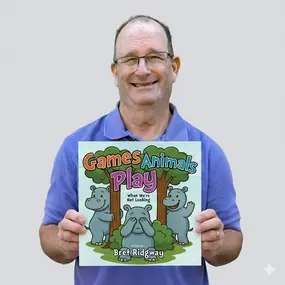
Bret Ridgway's author journey has taken him from being a bestseller in the publishing and public speaking niches to now entering the fun world of being a children's book author. His path has taken him from being a high-ticket telemarketer to a pioneer portal website developer, to the founder of Speaker Fulfillment Services.
In his earlier career he wrote eight business books but then grandchildren came along and he decided he wanted to write something they could enjoy and would be somewhat of his legacy. For some reason the silly phrase "crickets playing croquet" kept going through his mind and that one phrase was the impetus for writing "Games Animals Play (When We're Not Looking).
His previous bestselling business books included "Mistakes Authors Make" and "ABCs of Speaking."